



Gwen Donovan: Many items in your Yoomoota collection have a medical theme, why does that subject play a role in your designs?
Taras Zheltyshev: The subject matter of the objects is more natural rather than medical, as it involves several disciplines: chemistry, anatomy, physiology and biology. This field attracts me because, like many other artists, I create what surrounds me. I see that we are surrounded by a vast number of physiological, biological and physical processes.


GD: What sets your Pillbox design apart from less highly-designed pillboxes?
TZ: The distinction of the Pillbox from the Yoomoota universe lies in its intrinsic value, not just because of the presence of tablets. It serves as a sort of sarcophagus that holds the user’s health within it. Owning such a unique art object inevitably compels its owner to reflect more frequently on their own well-being, while the thoughtfully designed user experience significantly simplifies the daily life of anyone taking various types of tablets for prevention or treatment purposes.
GD: How can the Pillbox design enhance the well-being and quality of life of its owner?
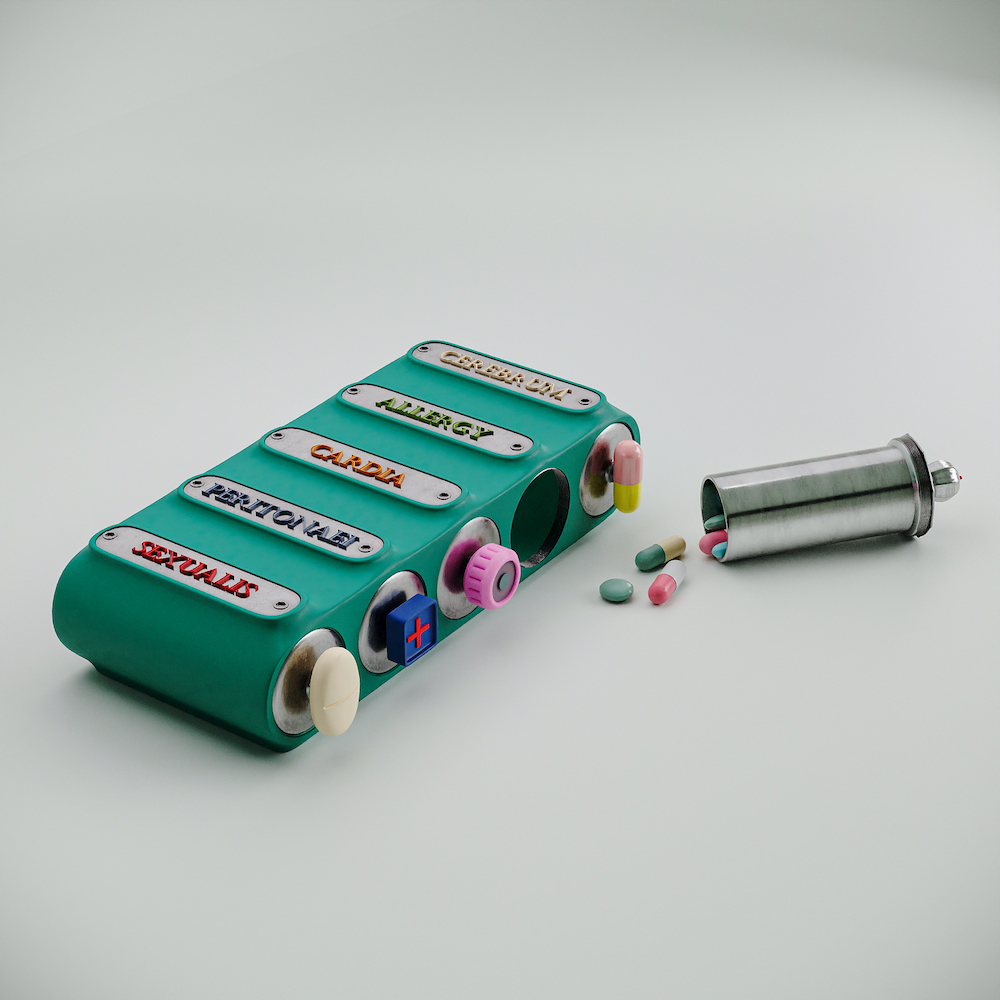
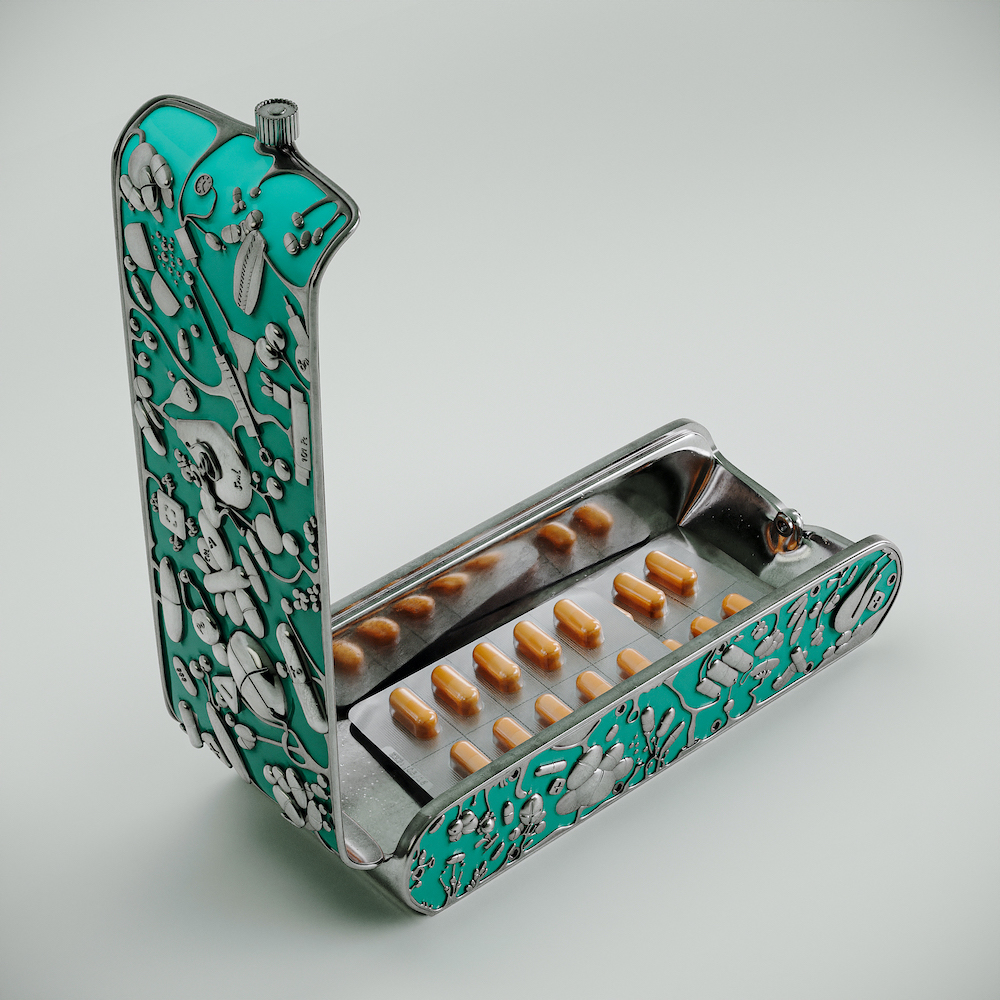
TZ: The Pillbox represents a meaningful symbol of medicine. It symbolizes a careful and meticulous approach to self-healing and one’s own body, which is why the details are crafted in an expensive handcrafted style made of silver with enamel. It is designed in two parts, one of which has a common compartment for tablets in the packaging, while the other features several twistable tubes.
GD: Which parts of Pillbox are accessible?
TZ: The Pillbox is equipped with additional features for individuals with disabilities. For example, each handle has its unique design and shape, making them easily distinguishable by touch. Each tube has a raised inscription indicating the category it is intended for, such as heart, allergy and others. This makes it simple for visually impaired individuals to use the Pillbox. Also, the choice of silver as the material is not arbitrary – it possesses natural antiseptic properties. Furthermore, the Pillbox is convenient to use, as one can consume a tablet by using the tube as a small cup, without the need to handle the tablets directly.
GD: Is accessibility an important way for you to communicate your artistic ideas?
TZ: Absolutely, the inclusivity of the product lies precisely in its creation for all people. The design concept is centered around providing equal convenience for both young and physically fit individuals, as well as for older individuals or those with visual impairments.
GD: Do you have a favorite aspect of Pillbox?
TZ: I truly appreciate the concept of the Pillbox, as I often find myself needing to take medication. It can be inconvenient when you have to take a pill while walking down the street, having to squeeze it out of the packaging and then place it in your mouth using your hands. Some may find this embarrassing, although it shouldn’t be. Therefore, I would like taking medication to be free of discomfort, allowing individuals to confidently carry the pillbox as an art object and use it without hesitation.
This or That? Choose the one that appeals most to you personally.
- First design sketch: computer software or pencil and paper? I enjoy creating pencil sketches, but I often find it more convenient to use a tablet since it’s more practical. Paper is better suited for the final product.
- Work schedule: early riser or night owl? Despite the fact that I wake up around 9am, my active working hours are during the night, starting from 8pm.
- Work style: collaborator or soloist? I enjoy the concept of collaboration, but finding a partner can sometimes be challenging, so I tend to work more as a solo artist.
- Workspace: light-filled studio or high-tech computer lounge? I have my workspace in a studio, but I often have to combine it with computer work. It’s convenient that my studio accommodates both areas, allowing me to seamlessly transition between physical art creation and digital tasks.
- Time off: beach vacation or mountain getaway? A mountain trip!
Read more of this series from aspire design and home editor Gwen Donovan, here.
Like what you see? Get it first with a subscription to aspire design and home magazine.