
 508 W 24th Street
The newest building that High Line visitors are seeing is a throwback to the controversial architectural style of Brutalism, made famous by the Swiss architect Le Corbusier.
While the spacious luxury apartments along West 24th Street may not embrace the initial socialist aspect of this midcentury movement, the building does reflect the solid structural beauty of Brutalist buildings. The huge, massive concrete forms with glass interplay create a juxtaposition resulting in a unique living area.
The defining building that launched the Brutalist movement was built in Marseille by Le Corbusier in 1952. It was a 12-story apartment complex that embraced raw concrete, glass and interacting living spaces. (The architect even built a roof-top garden long before millennials claimed this amenity as a must-have.)
“In the midcentury they were pouring things directly out of concrete,” explains Cary Tamarkin, the architect of 508 West 24th Street. “The super structure of the building is its skin.” The exposed concrete facade reveals the details of construction, where joints and even imprints from the concrete forms become celebrated features.
This ‘raw” construction process gained international notoriety for institutional buildings in the 1950s, and continued into the early ‘70s. Everything from the Embassy of Kuwait in Tokyo to the Preston bus station outside London embraced Brutalism. Tamarkin wanted to build upon this international heritage of the Brutalism movement, also known as Beton Brut, when it came to creating the building on 24th Street.
“I like things to feel under-architected and pared down – not screaming for attention,” he says.
The Brutalist style achieves that goal, bringing an international style to the area while simultaneously complementing the industrial heritage of West Chelsea.
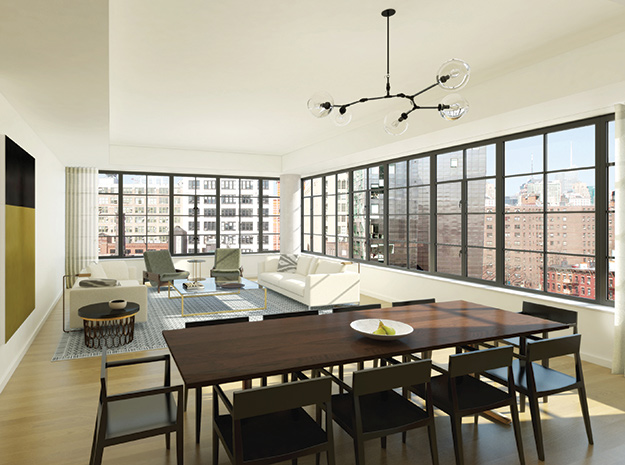
However, the style did need to be updated. Today’s consumers want their homes to be part of the entire city, not just part of one building. Tamarkin’s solution involved placing huge custom-built casement windows between the layers of concrete. The multipaned, steel frame windows not only create impressive rooms with amazing views of the city and High Line Park, but they also influence the interiors of the homes.
“These ribbon windows are fantastic from inside the apartments,” he states. “There is this continuing dance of windows, and the broken panes cast shadows. It changes all day long.” The custom-made steel windows have become a Tamarkin calling card. He continues, “The end goal is to have as thin a profile as possible from the street looking up and (from) the inside looking out.”
One other twist that Tamarkin added to the building was to place a huge exterior clock at the top of the main concrete column overlooking the High Line. This allows the building to give back to the city, creating an evolution of the time-honored, international design style that inspired it.
Like what you see? Get it first with a subscription to ASPIRE Metro Magazine