

Taken by its 19th century charm, passers-by stop and smile at The Sterling Mason condominium development in Tribeca. What deepens that smile is thinking of how beautiful this warehouse district was to begin with, given its elaborate outward detailing – gifts to the street unthinkable for warehouses today.

Here, a new building was added to a much older one in the familiar way two generations of closely related New Yorkers might sit together on a bench or at an outdoor cafe. Father and son or mother and daughter look alike in every feature; in the case of The Sterling Mason, the older one wears stucco while the younger is clad in all metal.
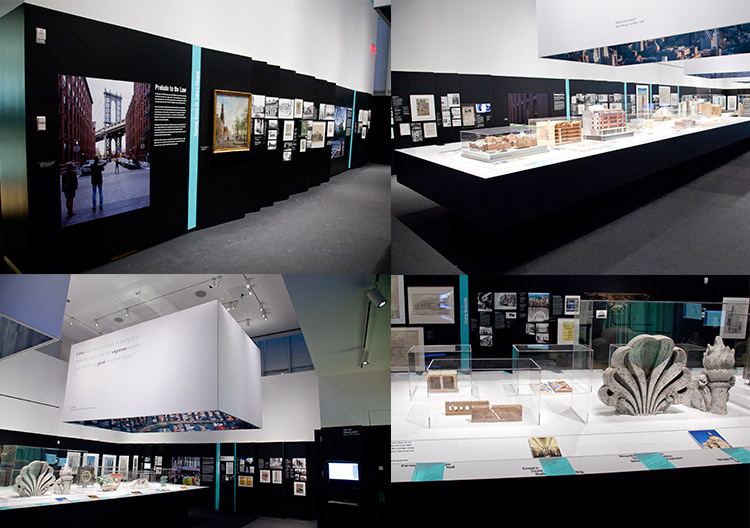
Celebrating the 50th anniversary of the Landmarks Law, the Museum of the City of New York recently displayed the “Saving Place” exhibit, in which the twinned buildings of The Sterling Mason were featured as proof that critics of the law were wrong. Rather than inhibiting growth, the law created an energetic tension between New York’s great architectural history and its dynamic, forward-looking culture, helping to drive its renaissance.
“We liked the idea of replicating the original historic building in scale and form, but making it contemporary by using new material,” tells “Saving Place” curator Donald Albrecht.

Because he has worked with Aldo Rossi (1931-1997) for 13 years, architect Morris Adjmi, one of the chief theorist and practitioners of architecture, has a reputation for creating new architecture in historic districts like Tribeca.
True to form, the architectural statement Adjmi made has less to do with creating a heroic, one-of-a-kind gesture and more to do with producing a knowing, smile-provoking riff on the passage of time. “One of my inspirations is the Grand Shrine of Ise in Japan,” shares Adjmi. “They rebuilt it every 20 years, taking pieces of the old building to make the new building, and in the process, they have the old building next to the new building, an acknowledgement that everything will ultimately age and transform.”

While many may now agree that respecting history and context is a good thing, one might wonder if it is ethically and aesthetically kosher to replicate the details of another building only in a different material the way Adjmi did. In Renaissance Florence, no one batted an eye at this; Filippo Brunelleschi created the great arcade of Florence’s Foundling Hospital, whose details later “starchitects” used freely in adjacent structures without suffering irreparable ego damage.
“The new metal-clad structure refers to the cast-iron structures that predominate in Tribeca,” says Adjmi. “They were painted to look like stone, but all the elaborate cornices, moldings and dentils are actually cast iron. Because of computer-aided manufacturing that has come along in the last 10 years, we were able to replicate these 19th century features in the new building.”
Thank modern technology for making such a link to the past physically possible, thank Adjmi for making his particular gift to the street provoke so many knowing smiles, and thank the Landmarks Law for fostering this level of ingenuity.
In the News: http://www.pressreader.com/usa/new-york-daily-news/20150910/281500750029718/TextView
PHOTOGRAPHY- GEORDIE WOOD
Like what you see? Get it first with a subscription to ASPIRE Metro Magazine